



 Triops Longicaudatus
 Triops Longicaudatus Red
 Triops Longicaudatus
 Triops Longicaudatus Red
 Triops food
 Sea almond leaf
 Aquarium filter
 Lighting
 Substrate
 Decoration
 Heating
 Cleaning
 Thermometer
Guide
The Mesozoic Era: The age of dinosaurs and major upheavals on Earth
The Mesozoic Era is considered one of the most fascinating geological periods in the history of our planet. It spans a period of approximately 252 to 66 million years ago and forms the link between the ancient Palaeozoic Era and the more recent Cenozoic Era. During these nearly 186 million years, the Earth underwent profound changes: continents drifted apart, new life forms conquered land, air and sea – and ultimately, one of the most dramatic mass extinctions in Earth’s history occurred. It is not without reason that the Mesozoic Era is often referred to as the ‘Age of Dinosaurs’. But this epoch was much more than just the stage for giant lizards. In this blog article, I will take you on a journey into the past.
A new beginning after the greatest catastrophe in the history of the Earth
The beginning of the Mesozoic era is inextricably linked to a global crisis. At the transition from the Palaeozoic era, around 90 per cent of all marine species and a large part of the terrestrial fauna died out in the largest known mass extinction. The Earth was almost biologically empty, but it was precisely this emptiness that created space for new developments.
In the early phase of the Mesozoic era, ecosystems recovered only slowly. Extreme temperatures, strong volcanic activity and high carbon dioxide levels characterised the climate. Nevertheless, new animal groups emerged from the surviving lines and diversified at an astonishing rate.
The Triassic period marks the first section of the Mesozoic era. The climate was predominantly hot and dry, with large parts of the Earth consisting of deserts. All continents were united into a vast supercontinent known as Pangaea.
During this period, the first dinosaurs appeared, initially small, lightly built and rather inconspicuous. At the same time, early mammalian ancestors developed, but they still lived in the shadow of the reptiles. A new golden age also began in the sea: ichthyosaurs and other marine reptiles occupied ecological niches that had previously remained empty.
Towards the end of the Triassic period, another mass extinction occurred, putting an end to many competing animal groups and paving the way for the dinosaurs to dominate.
The Jurassic period: the golden age of dinosaurs
The Jurassic period represents a phase of exceptional stability and biological development within the Mesozoic era. Once the massive upheavals of the Triassic period had been overcome, many animal and plant groups were able to evolve and specialise over millions of years. These comparatively calm environmental conditions made the Jurassic period a true golden age of evolution.
The climate was predominantly warm and humid, with only slight temperature differences between the equator and the poles. Large parts of the Earth were covered by lush forests of conifers, ferns and cycads. These extensive plant landscapes provided the energy basis for some of the largest land animals that ever existed.
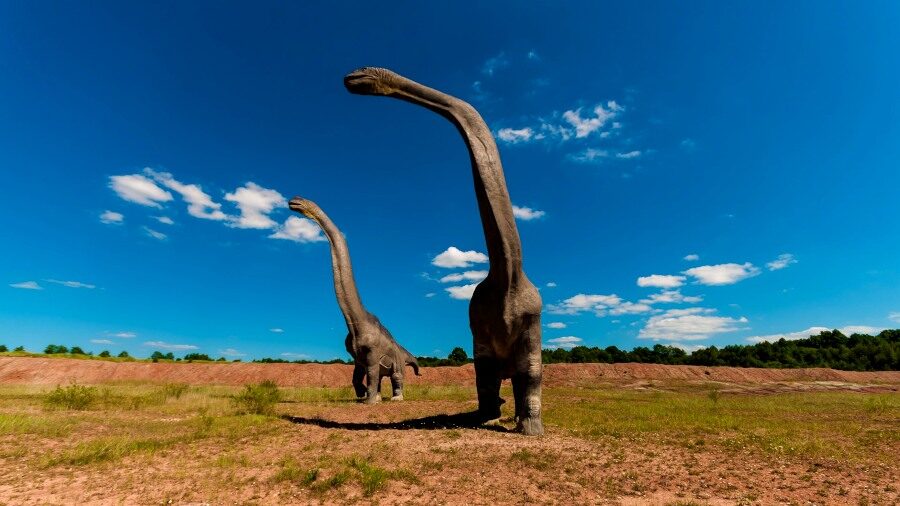
The rise of the gigantic sauropods was particularly significant for the Jurassic period. These long-necked herbivores reached body lengths of over 25 metres and weighed several dozen tonnes. Their enormous size offered protection from most predators and allowed them to utilise food sources that were inaccessible to other animals. Entire ecosystems were tailored to these giants, from the structure of the vegetation to the scavengers that benefited from dead animals.
At the top of the food chain were large predatory dinosaurs that were perfectly adapted to hunting. With powerful hind legs, sharp teeth and keen senses, they dominated their habitats. During the Jurassic period, highly specialised hunters first developed, whose physiques were designed for speed, strength or endurance. This diversity of hunting strategies suggests that ecosystems were complex and finely balanced.
The airspace was not empty either. Pterosaurs used thermal updrafts and coastal winds to cover long distances. They occupied ecological niches that are now occupied by birds or bats. At the same time, the first true birds emerged from small, feathered dinosaurs. This evolutionary transition is one of the most significant developments in the history of the Earth and shows how fluid the boundaries between large animal groups can be.
The seas of the Jurassic period were just as rich in species as the land. Shallow shelf seas covered large parts of the continents and provided habitat for a variety of organisms. Ammonites and belemnites served as important prey, while large marine reptiles occupied the top positions in the marine food chains. Reefs and underwater landscapes developed into hotspots of biodiversity.
Geologically, the Jurassic was also a period of change. The gradual break-up of Pangaea continued, creating new coastlines, ocean currents and climate zones. These changes promoted regional diversity of life and accelerated the evolutionary differentiation of many species.
The chalk: heyday, innovation and abrupt end
The Cretaceous period was the last and most dynamic part of the Mesozoic era. It lasted for almost 80 million years and was marked by major biological innovations, global environmental changes, and an unmatched variety of life forms. In many ways, the Cretaceous was a high point in evolution, but it was also an era whose end was one of the most dramatic events in Earth’s history.
The climate of the Cretaceous was warm overall, at times even significantly warmer than today. There were no polar ice caps, and sea levels were considerably higher. Large parts of today’s continents were covered by shallow, warm seas, which further stabilised the climate. These conditions favoured enormous productivity in both terrestrial and aquatic ecosystems.
One of the most significant developments of the Cretaceous period was the emergence and rapid spread of flowering plants. They fundamentally changed the landscape and led to new ecological relationships. Insects that pollinated flowers diversified greatly, which in turn had an impact on reptiles, birds and early mammals. Forests and plains became more structured, food chains more complex and habitats more diverse than ever before.
Dinosaurs reached their greatest diversity in the Cretaceous period. In addition to gigantic herbivores, there were highly specialised species with horns, bone collars or massive armour. Others developed efficient chewing apparatus that enabled them to digest hard plant matter. This is a clear indication of the close interaction between the plant and animal worlds. There was also a great deal of differentiation among the predatory dinosaurs, ranging from agile hunters to massive apex predators.
At the same time, mammals continued to evolve, albeit mostly in secret. They were predominantly small, nocturnal and occupied ecological niches that were hardly used by dinosaurs. Nevertheless, important lineages emerged in the Cretaceous period, from which the diversity of today’s mammals would later develop. Birds also diversified greatly and conquered new habitats.
The oceans of the Cretaceous period were hotspots of biodiversity. Plankton-rich seas formed the basis for complex food chains, at the top of which were large marine reptiles and early shark species. At the same time, microscopic organisms played a central role in the global carbon cycle. This is an aspect that is still important for our understanding of the climate today.
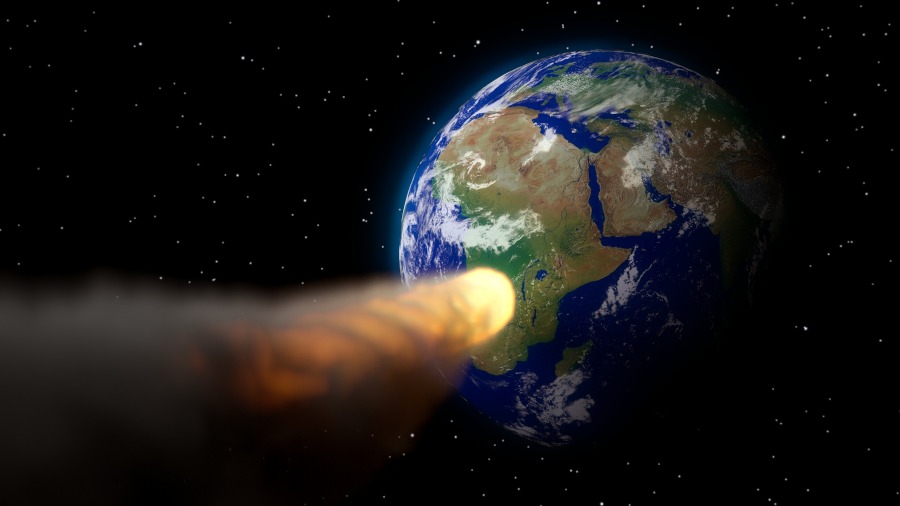
The end of the Cretaceous period came abruptly and unexpectedly. Within a short period of time, ecosystems around the world collapsed. A massive asteroid impact, exacerbated by prolonged volcanic activity, led to darkness, cooling and the collapse of photosynthesis. Around 75 per cent of all species disappeared, including all non-avian dinosaurs. This catastrophe marks the end of the Mesozoic era and the transition to a new world order.
The legacy of the Mesozoic era
Although the Mesozoic era ended 66 million years ago, its legacy continues to this day. Birds are direct descendants of dinosaurs, many plant lines originated during this period, and the basic distribution of the continents was decisively shaped.
The Mesozoic Era is also of central importance from a scientific perspective. It shows how resilient life can be, but also how vulnerable complex ecosystems are to global change. Climate change, species extinction and environmental upheaval are not modern phenomena; they have accompanied the history of the Earth since its earliest chapters.
An era full of dynamism and contrasts – Conclusion
The Mesozoic era was much more than just the “age of the dinosaurs”. It was one of the most formative periods in the history of the Earth, during which the foundations of today’s biosphere were laid. Over a period of almost 186 million years, this epoch demonstrated how closely evolution, climate, geology and life are intertwined. Continents broke apart, oceans formed and disappeared, and life forms repeatedly adapted to new conditions or disappeared forever.
The enormous innovative power of life during this period is particularly impressive. From the ruins of earlier mass extinctions, highly complex ecosystems developed with unprecedented diversity. Dinosaurs, marine reptiles and pterosaurs dominated their habitats, while the ancestors of today’s birds and mammals were already laying the foundations for a new era in secret. Many evolutionary breakthroughs that define our world today date back directly to the Mesozoic era.

- The flying jewel in the garden pond: the fascinating world of butterfly koi - 28. December 2025
- The Mesozoic Era: The age of dinosaurs and major upheavals on Earth - 27. December 2025
- The right water for triops: the key to successful breeding - 26. December 2025
